
Sr. Director, Marketing Operations
Driving Revenue Operations at Scale Across Complex Enterprise Environments
Marketing Operations is often described through the machinery of the function: technology, data, processes, reporting, and campaign execution. But at the senior leadership level, mastery of the machinery is only valuable if it produces better decisions, stronger alignment, and more predictable growth.
This resume reframes Marketing Operations as the operating system behind revenue. It connects the candidate’s early experience in enterprise sales with their progression into marketing leadership, creating a cohesive story about someone who understands both what growth requires on the front lines and how to build the infrastructure that makes it repeatable.
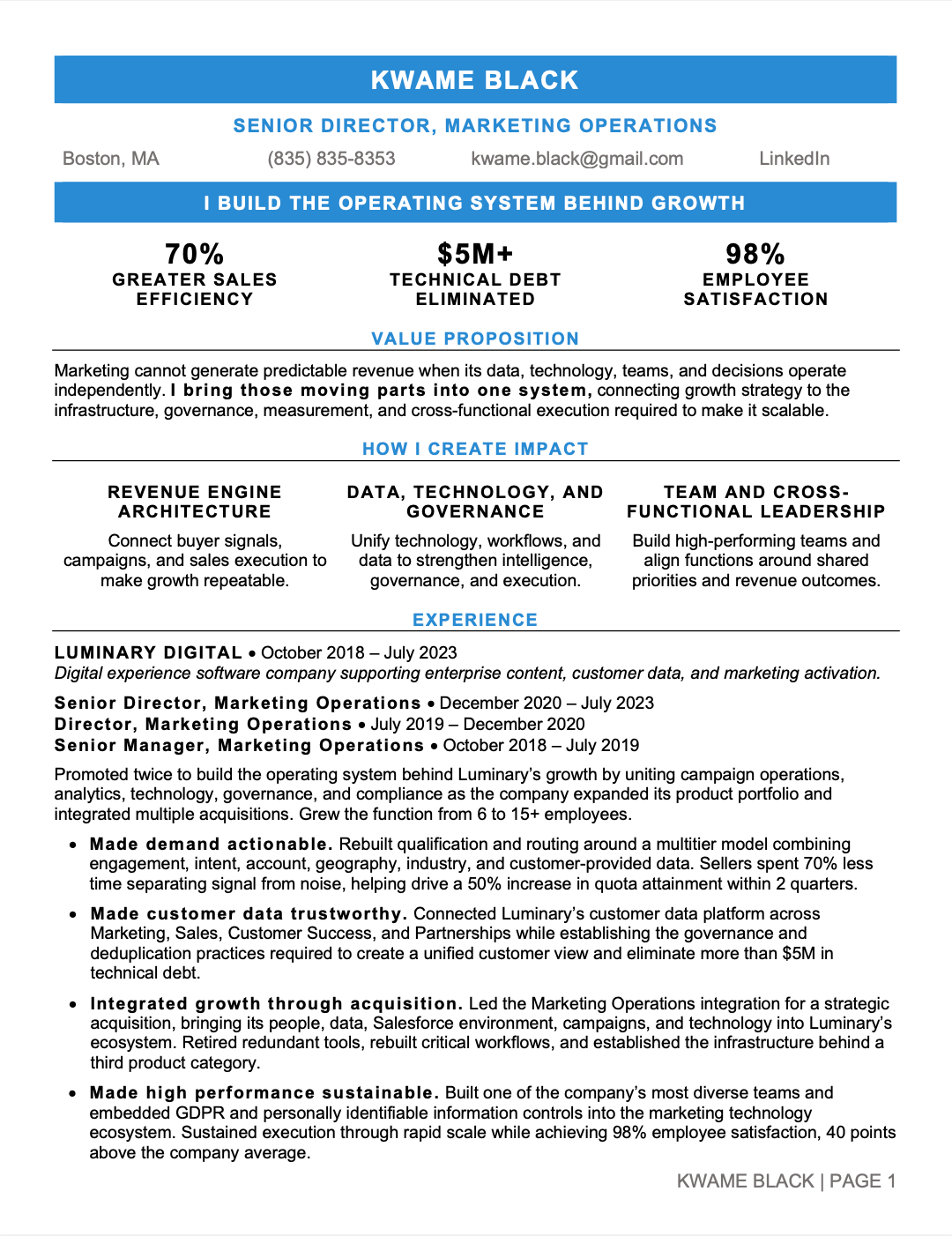
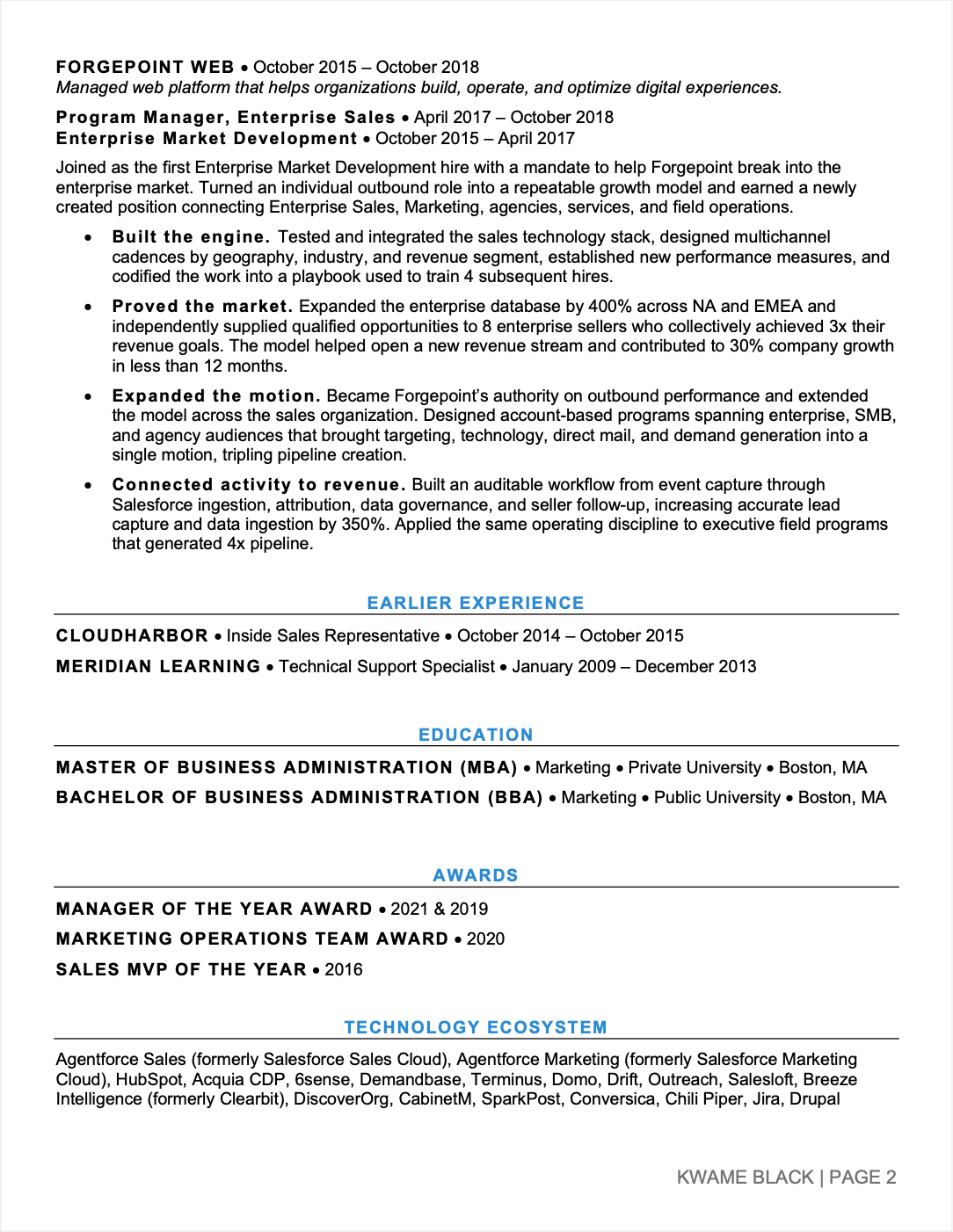
The opening page establishes that positioning immediately, pairing a clear leadership philosophy with evidence of commercial, operational, and organizational impact. The experience section then carries the story forward through a series of business problems solved, not responsibilities performed, showing how the candidate turned fragmented data, technology, teams, and workflows into a coordinated revenue engine.
*Client details have been modified to protect confidentiality while preserving the strategic positioning and outcomes.
Marketing Operations Is Not a Support Function. It Is the Infrastructure Behind Growth.
The strongest Marketing Operations leaders do far more than administer technology, manage campaigns, or produce reports. They determine whether customer intelligence can be trusted, whether buyer signals reach the right sellers, whether teams can make informed decisions, and whether a company’s growth strategy can scale without collapsing under operational complexity.
The resume needed to make that level of influence unmistakable.
The Situation
This Senior Director had built an unusually valuable career at the intersection of Marketing, Sales, technology, data, and operations. They had created new revenue motions, unified customer information across multiple functions, integrated an acquisition, eliminated millions of dollars in technical debt, and built a highly engaged team.
But the breadth of that work created a positioning problem.
Marketing Operations encompasses dozens of platforms, processes, stakeholders, and responsibilities. Without a clear strategy, the resume could easily become an inventory of systems managed and programs delivered—technically impressive, but disconnected from the business outcomes senior leaders are hired to produce.
What Wasn’t Working
The candidate’s accomplishments were strong, but the larger leadership story was easy to miss.
Their early career in enterprise sales could appear unrelated to their later success in Marketing Operations. Their technology expertise risked positioning them as a systems specialist rather than an enterprise leader. Their operational work could be interpreted as supporting growth instead of actively shaping it.
Most importantly, the resume needed to explain how seemingly different accomplishments—from lead routing and customer data governance to acquisition integration and team development—were all expressions of the same capability.
What We Changed
We built the resume around one central idea: This leader builds the operating system behind growth.
That positioning transformed the career story. Their foundation in enterprise sales became an advantage, demonstrating firsthand understanding of how sellers identify opportunities, interpret buyer signals, and convert activity into revenue. Their progression into Marketing Operations then showed an expanding ability to build the infrastructure required to make that performance repeatable.
The opening page establishes the argument before asking the reader to interpret a detailed career history. Three high-value outcomes—70% greater sales efficiency, more than $5 million in technical debt eliminated, and 98% employee satisfaction—immediately communicate commercial, operational, and organizational range.
The “How I Create Impact” section then defines the three capabilities behind those results:
- Revenue engine architecture
- Data, technology, and governance
- Team and cross-functional leadership
Together, these elements give the reader a framework for understanding everything that follows.
Why This Works
Senior-level resumes should not make the reader assemble the candidate’s value from a collection of responsibilities and achievements. They should present a clear leadership thesis and then prove it.
Every accomplishment in this resume advances the same argument. Rebuilding qualification and routing was not simply a process improvement; it reduced the effort sellers spent separating signal from noise by 70% and helped increase quota attainment by 50%.
Connecting the customer data platform was not merely a technology initiative; it created a unified customer view across Marketing, Sales, Customer Success, and Partnerships while eliminating more than $5 million in technical debt.
Integrating an acquisition was not a list of migration activities; it established the infrastructure behind an entirely new product category.
Building a diverse, highly engaged team was not separated from business performance; it demonstrated the leadership required to sustain execution through rapid growth and change.
The result is a resume that translates Marketing Operations into the language of the business without diminishing the functional sophistication behind the work.
The Bigger Point
Many senior professionals have more strategic careers than their resumes suggest. They have solved problems across functions, influenced decisions beyond their formal authority, and built systems that changed how the organization performs. But when their resumes are organized around job descriptions, tools, or isolated accomplishments, that level of leadership disappears.
A strong executive resume does not simply document what happened. It identifies the pattern behind the work.
This candidate did not just improve campaigns, implement platforms, or manage a Marketing Operations team. They repeatedly found the points where disconnected data, technology, processes, and people were constraining growth—and built the structure required to bring them together.
That is the story senior leaders need hiring decision-makers to recognize.
The Result
The finished resume positions this candidate as a commercially minded Marketing Operations executive with the range to connect strategy and execution. It is technically credible without reading like a technology inventory. It demonstrates leadership without relying on generic executive language. And it makes the candidate’s progression from enterprise sales to Marketing Operations feel intentional, differentiated, and directly relevant to the work they are prepared to lead next.
Most importantly, it gives hiring leaders a clear answer to the question every senior-level resume must resolve: What becomes possible when this person joins the organization?
In this case, fragmented growth activity becomes a coordinated, scalable revenue engine.
Ready to Fix the Gap?
If your resume doesn’t clearly show how your work connects to pipeline, revenue, and business outcomes, you’re likely being evaluated below your actual level.
I work with senior leaders to reposition their experience so it lands the way it should.