
Senior Product Manager
Positioning a Proven Product Leader When Her Most Recent Role Only Tells Part of the Story
What happens when a candidate’s strongest results come from earlier roles, but hiring teams are likely to focus most heavily on the latest one?
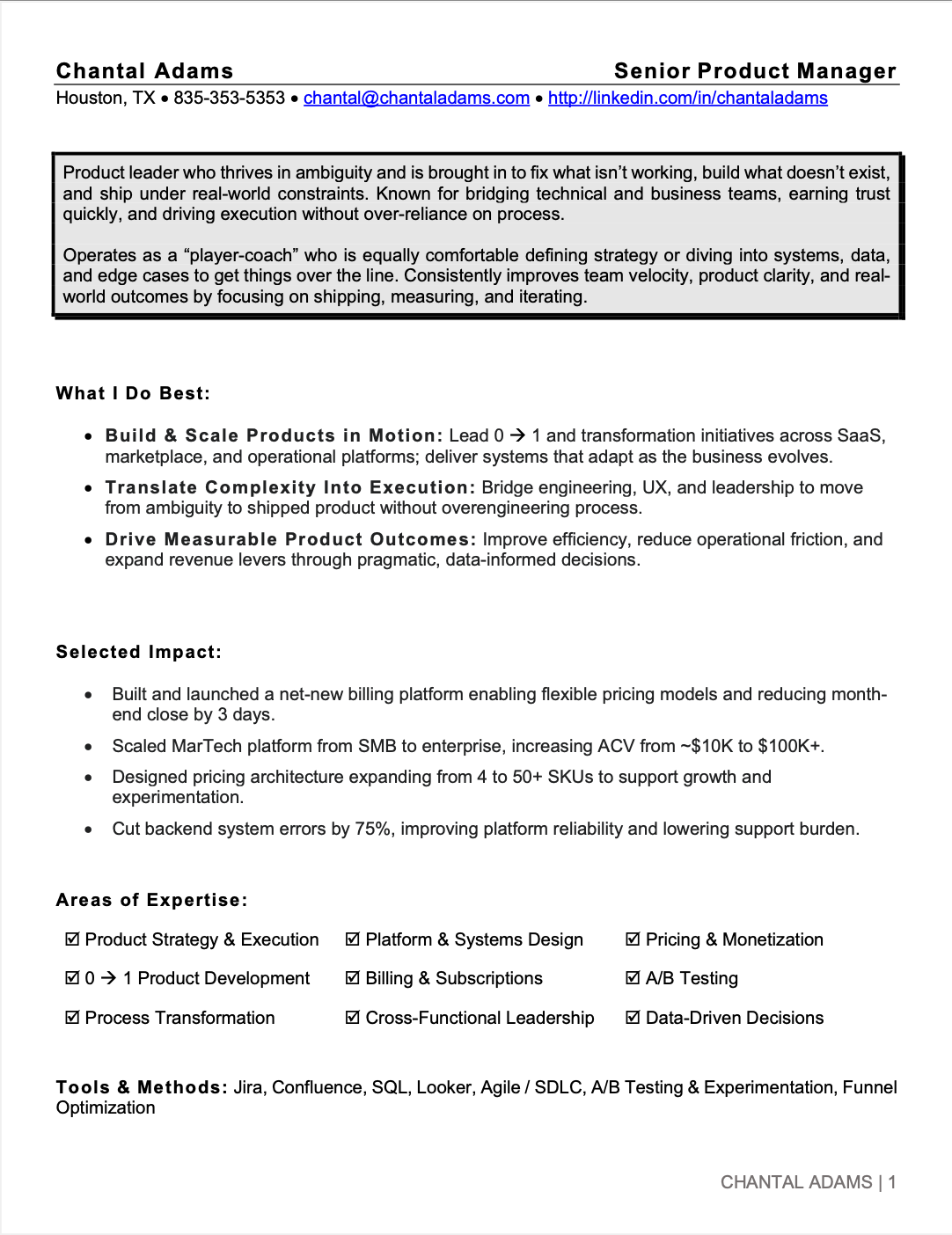
This Senior Product Manager had an impressive record of measurable impact, including building a billing platform that shortened the monthly close by 3 days, expanding pricing from 4 to more than 50 SKUs, and helping scale a MarTech product from approximately $10k to more than $100k in annual contract value. Her most recent employer, however, had an immature product environment where much of her work involved establishing the foundations for future results.
We elevated selected outcomes from across her career onto the first page, while positioning her recent work around its true value: modernizing legacy systems, improving delivery, and creating alignment across a complex organization. The result is an honest, strategically balanced resume that shows both what she has already proven she can deliver and how she creates progress when the conditions for success are still being built.
*Client details have been modified to protect confidentiality while preserving the strategic positioning and outcomes.
What Happens When Your Most Recent Role Has the Fewest Results?
Hiring teams unconsciously give the greatest weight to a candidate’s most recent experience. But the most recent role is not always the one that produces the strongest metrics or is the most relevant.
Sometimes the organization is too immature. The infrastructure is too fragmented. The product function lacks authority. The company is resistant to change. Instead of scaling a healthy product engine, the leader spends their time establishing the basic conditions required for meaningful results.
That work can be enormously valuable, and remarkably difficult to represent on a resume.
The Situation
This Senior Product Manager had a strong history of measurable product impact.
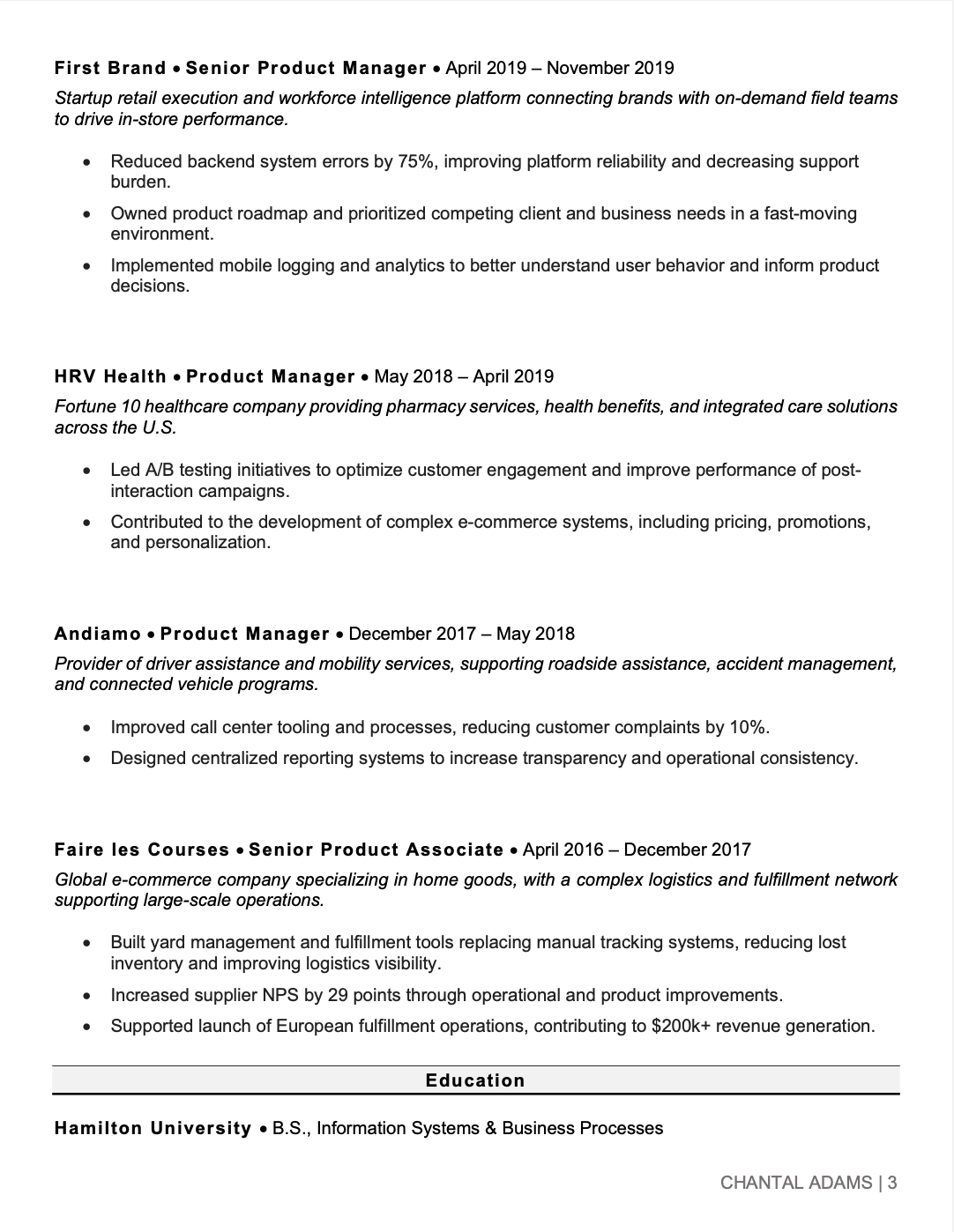
She had built a billing platform that reduced the monthly close by three days, expanded a pricing architecture from four to more than 50 SKUs, helped scale a MarTech product from approximately $10,000 to more than $100,000 in annual contract value, reduced backend errors by 75%, and increased supplier NPS by 29 points.
Her most recent role was different.
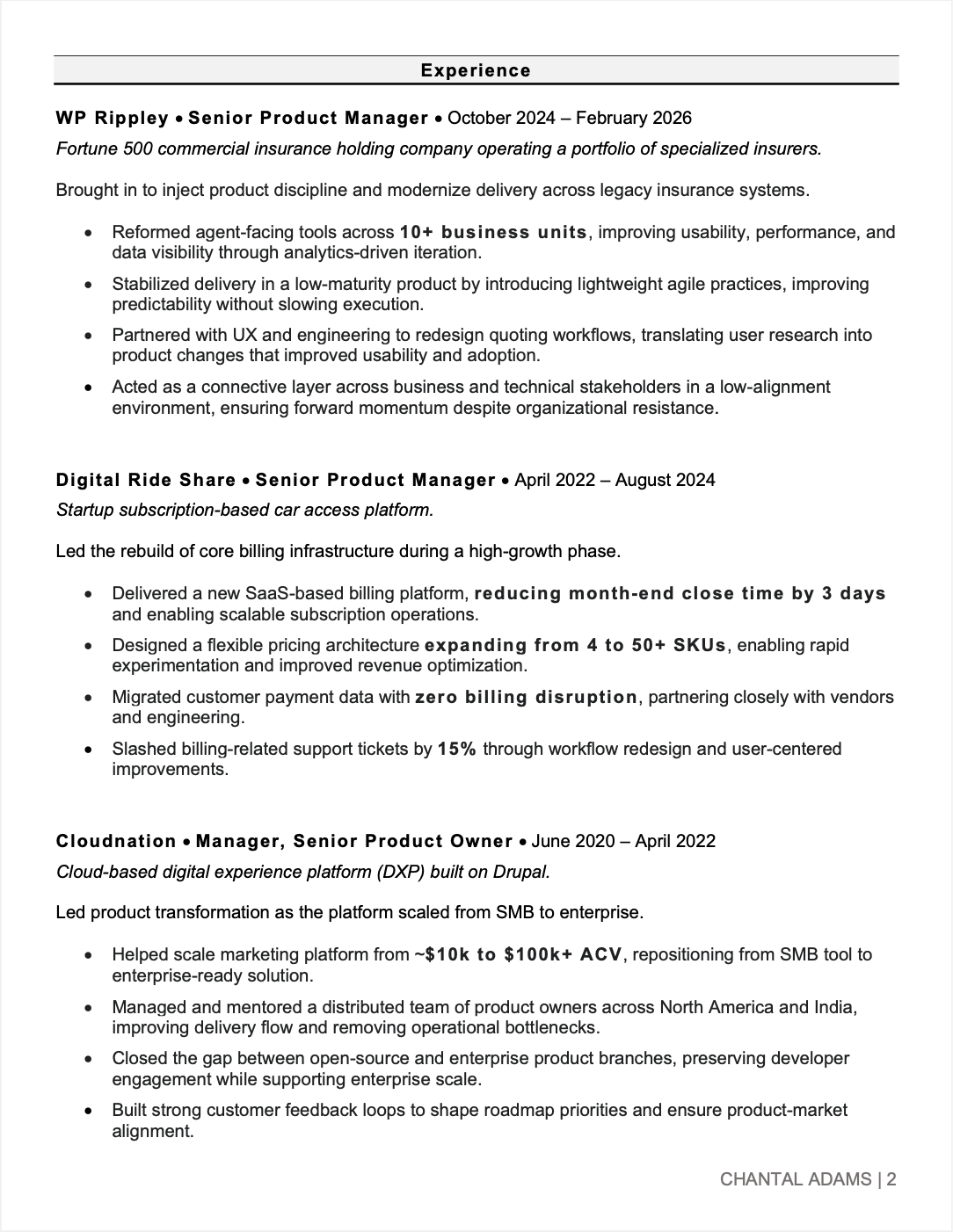
She had joined a large, complex insurance organization with low product maturity, legacy systems, inconsistent delivery practices, and limited alignment between business and technical stakeholders. Much of her work involved introducing product discipline, improving collaboration, and creating the foundation for better delivery.
The contribution was real. The downstream results had not yet fully materialized.
What Wasn’t Working
Because the most recent role occupied the most prominent position in the chronology, its lack of metrics threatened to weaken the entire resume.
A reader could see 4 strong, unquantified bullets followed by more impressive numerical results in earlier positions. Without context, that pattern might suggest that the candidate’s impact had declined as her career progressed.
That was not the story.
The difference was not the candidate’s capability. It was the maturity of the environment and the type of work the organization needed from her.
The resume had to explain that distinction without making excuses, criticizing the employer, inventing outcomes, or burying the most recent experience beneath older accomplishments.
What We Changed
1. Named the Mandate Behind the Most Recent Role
We opened the role by explaining why she had been brought in: to introduce product discipline and modernize delivery across legacy insurance systems.
This reframes the experience immediately. The reader understands that she did not inherit a mature product organization with established systems and clean performance data. She entered an environment that first needed greater structure, alignment, and product capability.
2. Demonstrated Progress Without Manufacturing Results
When mature outcome metrics are unavailable, the answer is not to inflate activity into impact.
Instead, we showed the meaningful changes she was able to influence: reforming agent-facing tools across more than 10 business units, introducing lightweight agile practices, redesigning quoting workflows, and creating alignment between technical and business stakeholders.
These bullets remain credible because they describe the scale, complexity, and strategic purpose of the work without claiming results the organization could not yet substantiate.
3. Used Earlier Results as Evidence of Established Capability
The strongest metrics were not hidden simply because they came from earlier roles.
We elevated them into a “Selected Impact” section on the first page, where they establish the candidate’s record before the reader enters the chronology. This makes it clear that the absence of recent metrics is situational—not a reflection of her overall ability to deliver results.
Her prior accomplishments become evidence of what she can produce when the organizational conditions allow the work to mature.
4. Built a Consistent Identity Across Mature and Immature Environments
The resume positions her as a product leader who enters complicated environments and creates forward motion. In more mature organizations, that work produced measurable gains in revenue, pricing flexibility, operational efficiency, customer experience, and platform reliability. In the most recent role, it meant improving the systems, practices, and stakeholder alignment required to make those outcomes possible. The form of the impact changed. The underlying capability did not.
5. Preserved a Traditional Structure While Controlling the Narrative
We intentionally retained a more traditional layout for this sample. The format gives recruiters the familiar chronology they expect, while the first-page positioning and role introductions provide the context they need to interpret it accurately. Rather than disguising the imbalance between recent and earlier results, the resume explains it.
Why This Works
A blip in your career does not discredit a record of success.
It does need to help the reader distinguish between 3 things:
- The results the candidate personally influenced
- The foundational work required before results could occur
- The organizational conditions that affected what could reasonably be measured
This approach remains honest without allowing the most recent employer’s limitations to define the candidate’s market value.
It shows that she can produce measurable outcomes in environments ready to support them, and build the product discipline required in environments that are not there yet.
The Bigger Point
Your most recent role may not contain your most impressive accomplishments.
Perhaps the company changed direction. Leadership never implemented the strategy. The organization lacked reliable data. The product was still too early. The operating environment made progress slower than expected. Or you were hired to build foundations whose value would not be fully visible until later.
None of those circumstances erase the results you created elsewhere.
The strategic challenge is to tell the truth about the most recent role while ensuring that employers evaluate your capability across the full arc of your career—not through one incomplete chapter.
The Result
The finished resume does not pretend that every role produced the same kind of impact.
Instead, it presents a more credible and sophisticated story: A pragmatic Senior Product Manager with a proven record of measurable product outcomes, and the judgment to create progress even inside immature, low-alignment environments.
Her earlier metrics establish what she is capable of delivering. Her most recent experience demonstrates that she can also operate when the systems, processes, and organizational conditions are still being built.
Together, they tell a stronger story than either could alone.
Ready to Fix the Gap?
Your most recent role should provide context for your career, not place a ceiling on it.
At Ivy Blossom Recruits, I do more than rewrite bullets. I identify where your resume is creating the wrong conclusion, then rebuild the narrative so employers understand the value behind your experience.