

Principal Engineering Architect Resume Example
Repositioning Executive-Level Technical Breadth for High-Impact IC Leadership
After serving as Chief Technology Officer, Archie was not seeking another executive title. He wanted to continue as a high-level individual contributor and solve the architecture, performance, and productization problems where he creates the greatest value.
The challenge was to make that choice look intentional rather than like a step backward.
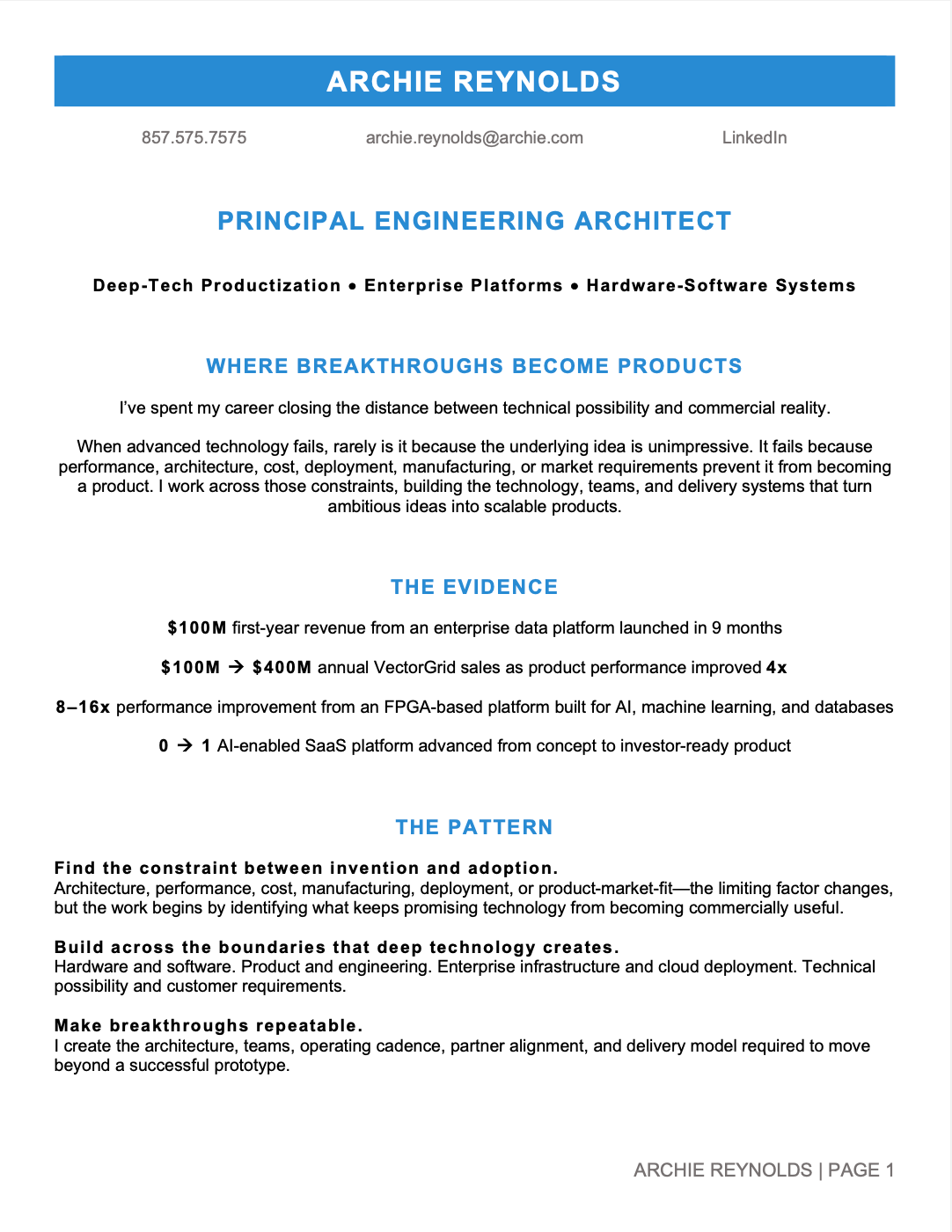
We positioned Archie as a Principal Engineering Architect who closes the distance between technical possibility and commercial reality.
Across startups and global enterprises, he has repeatedly identified the constraint preventing advanced technology from becoming a viable product and then engineered it out.
The resume connects achievements that might otherwise appear unrelated and rather than presenting his CTO role as the culmination of his career, the resume uses it as evidence of the commercial judgment he brings to technical work.
The result is a cohesive identity that preserves his executive-level scope while positioning his for the hands-on, high-impact engineering leadership roles he actually wanted.
*Client details have been modified to protect confidentiality while preserving the strategic positioning and outcomes.
Advanced Technology Does Not Become a Product by Accident
A breakthrough can be technically extraordinary and still fail to create meaningful business value.
Performance may not hold at scale. Infrastructure may be too expensive. Deployment may be too complex. Hardware and software may not work together cleanly. Manufacturing, compliance, or customer requirements may expose constraints that were invisible in the prototype.
Closing that distance requires a particular kind of technical leader, one who can see the entire system surrounding the technology and engineer what must happen next.
That is the central idea behind Archie’s resume.
His career spans hardware, software, cloud infrastructure, databases, AI, product development, manufacturing, and technical leadership. But the value of that range is not simply that he understands many technologies.
Archie repeatedly turns advanced technology into viable products.
The Situation
Archie had built a career with unusual technical breadth and commercial consequence.
His experience included:
- Launching an enterprise data platform that generated $100M in first-year revenue
- Supporting growth from $100M to $400M in annual sales as product performance improved 4×
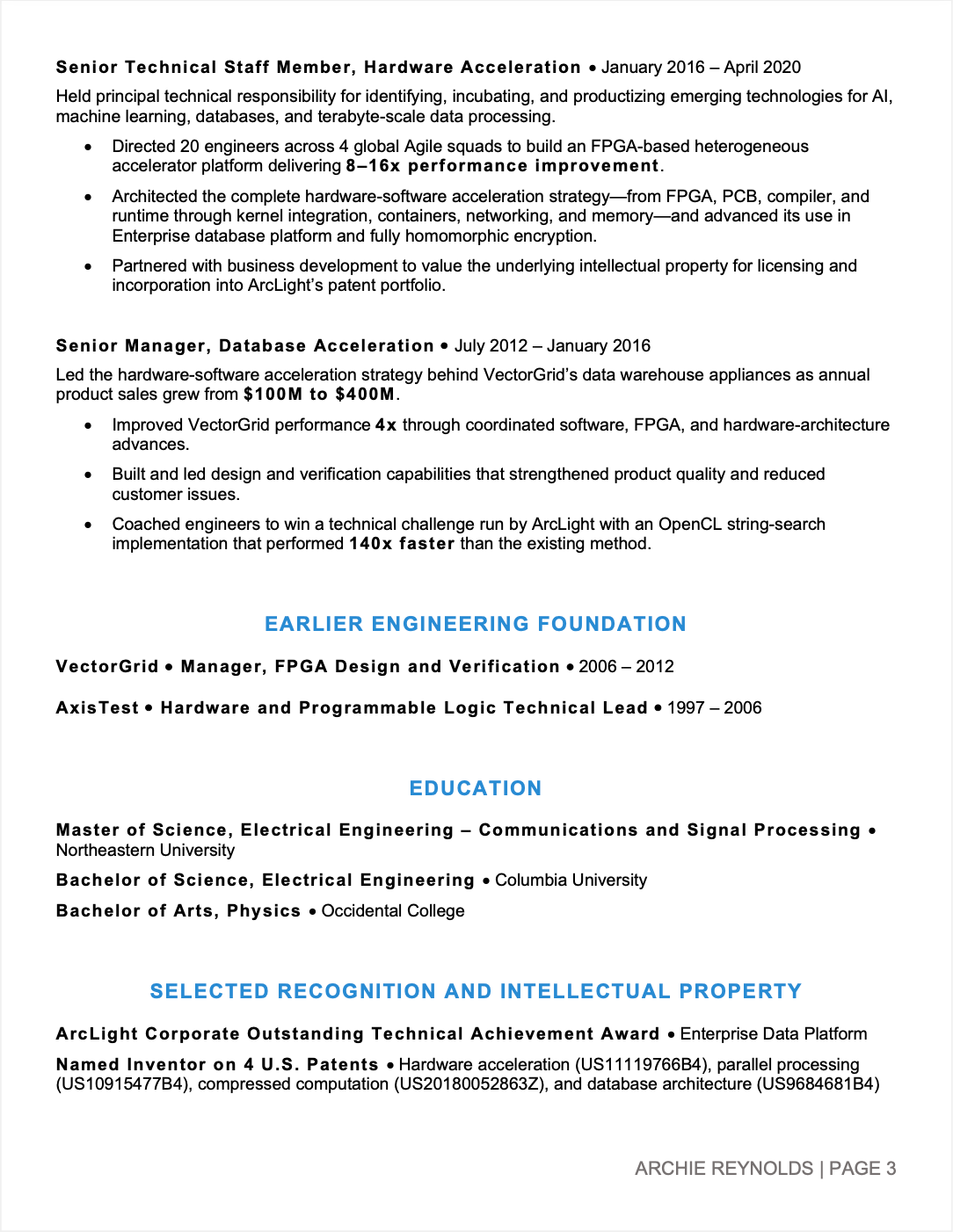
- Building an FPGA-based accelerator platform that improved performance 8–16×
- Developing an AI-enabled SaaS product from concept to investor-ready
- Leading globally distributed engineering teams
- Working across hardware, software, cloud infrastructure, manufacturing, compliance, product management, and business development
- Contributing to four U.S. patents involving hardware acceleration and database architecture
He had also served as Chief Technology Officer.
But Archie was not pursuing another CTO position. He wanted to continue doing high-level individual-contributor work: identifying difficult technical constraints, defining architectures, and guiding sophisticated technology toward successful deployment.
The resume therefore needed to preserve the significance of his executive experience without positioning executive advancement as the next logical step.
What Wasn’t Working
Archie’s original resume contained extraordinary technical material, but the larger career pattern was difficult to see.
- The technology overshadowed the value it created. FPGA, Kubernetes, OpenShift, AWS, compilers, databases, cloud infrastructure, and hardware architecture demonstrated range, but they did not explain what Archie consistently accomplished with that expertise.
- The achievements appeared to belong to different careers. Building a SaaS company, accelerating database performance, developing programmable hardware, and launching an enterprise platform could look like unrelated technical chapters.
- The CTO title distorted the destination. Hiring teams could reasonably assume that Jason wanted another executive role, even though his preferred work was technical rather than organizational.
- Pursuing another individual-contributor work could be misread as a career failure. Without the right framing, moving from CTO to Engineering Architect might appear to represent reduced ambition or scope.
- Technical depth and commercial judgment competed for attention. Emphasizing one risked making the other seem secondary.
- The strongest metrics lacked a governing idea. Large revenue and performance numbers were impressive, but the resume did not explain why Archie had repeatedly been able to produce them.
The challenge was not making Archie appear more accomplished. It was making the logic of those accomplishments unmistakable.
What We Changed
1. Identified Productization as the Career Throughline
We began with a more useful question than “What technologies does Archie know?”
What becomes possible because Jason understands all of them?
The answer was productization.
Archie sees where advanced technology is getting trapped between invention and adoption. Depending on the product, the constraint might involve performance, architecture, infrastructure, cost, manufacturing, deployment, compliance, or product-market fit. He then works across those boundaries to remove it.
This idea connected the entire career. Archie was not moving unpredictably between hardware, software, cloud, databases, AI, and SaaS. He was going wherever the unresolved constraint stood between a promising technology and a viable product.
That became the governing idea of the resume: Where breakthroughs become products.
2. Positioned Individual-Contributor Work as a Deliberate Choice
A conventional executive resume would have treated Archie’s CTO role as the culmination of his career and positioned him for the next executive title.
That would have told the wrong story.
Archie’s value is not dependent on his position in an organizational hierarchy. He can operate with executive-level perspective while remaining close to architecture, engineering, and product development.
We positioned him as a Principal Engineering Architect: a senior technical authority who understands not only whether something can be built, but what it will take to deploy, scale, fund, manufacture, and commercialize it.
The CTO experience remained important, but its meaning changed. It became evidence that Jason understands the full commercial system surrounding technology—not an instruction that he must continue moving away from technical work.
3. Connected Technical Decisions to Product Economics
Senior technical resumes frequently describe architecture as though technical superiority were the final outcome. Archie’s work demonstrated something larger. His architectural decisions affected:
- Time to market
- Infrastructure and development costs
- Product performance
- Customer pricing
- Deployment flexibility
- Manufacturing requirements
- Enterprise adoption
- Revenue potential
We made those relationships explicit.
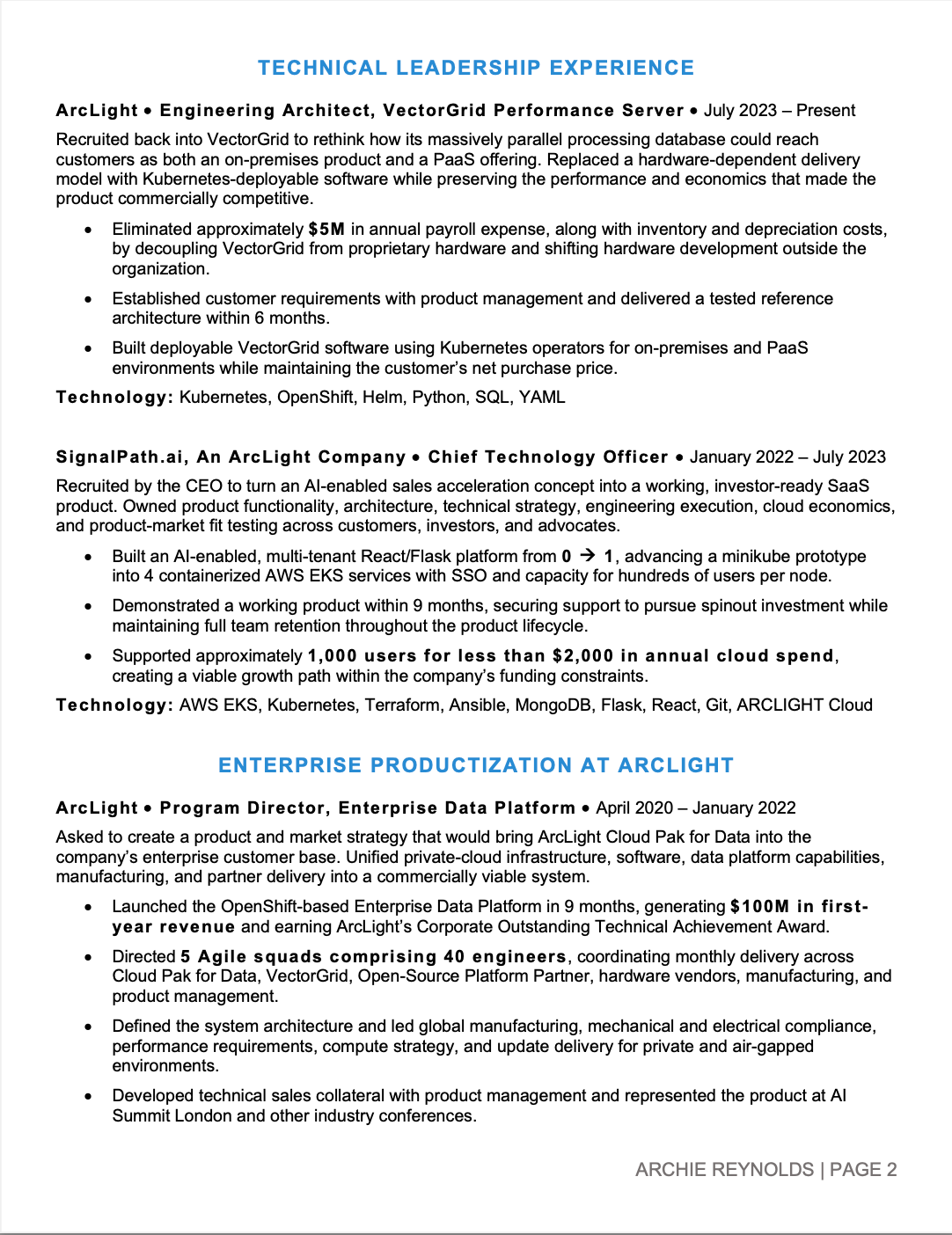
Replacing proprietary hardware was not simply an architectural modernization. It removed inventory, depreciation, and approximately $5M in annual payroll expense while expanding how customers could deploy the product.
Building a cloud platform capable of supporting approximately 1,000 users for less than $2,000 annually was not merely efficient infrastructure. It created a viable growth path within tight funding constraints.
Improving performance was not an isolated engineering accomplishment. It occurred as annual product sales grew from $100M to $400M.
The resume does not separate technical sophistication from business value because Jason’s work does not separate them.
4. Used Technical Detail Strategically
Jackson’s technical vocabulary matters. Recruiters searching for high-level engineering talent use technologies, architectures, platforms, and technical domains to find candidates. Removing those details in pursuit of a more “executive” presentation would have made the resume less searchable and less credible for the work Archie wanted.
We retained the relevant technical language, including cloud platforms, orchestration technologies, programming environments, databases, programmable hardware, compilers, and infrastructure.
What we changed was the hierarchy. The technologies now support the story rather than becoming the story. Each is connected to a product challenge, architectural decision, or measurable result.
This allowed the resume to serve two audiences simultaneously:
- Recruiters searching for specific technical expertise
- Senior leaders evaluating whether Archie can solve commercially consequential engineering problems
5. Made the Metrics Prove a Repeatable Capability
The resume contains unusually strong evidence, but the numbers were not treated as isolated highlights. Each proves a different part of Archie’s productization model:
- Revenue demonstrates commercial viability.
- Performance demonstrates technical advantage.
- Delivery speed demonstrates execution.
- Reduced cost demonstrates stronger product economics.
- Cloud efficiency demonstrates scalability under constraint.
- Patents demonstrate original technical contribution.
Together, they show that Archie’s ability to move technology toward the market is not tied to one product, company, or technical domain.
It is a repeatable way of working.
6. Designed the Resume Around an Engineering Argument
A conventional technical resume would have opened with a summary, followed by a technology inventory and chronological list of responsibilities.
Instead, the first page establishes an argument. Archie closes the distance between technical possibility and commercial reality.
The evidence section demonstrates the scale at which he has done it. The pattern section explains how he works. The experience then substantiates the idea across startup SaaS, enterprise data platforms, hardware acceleration, cloud infrastructure, and database architecture.
The design uses disciplined hierarchy, restrained color, and clear editorial pacing to help the reader understand the relationship between technical work and commercial outcomes.
The resume does not ask the reader to assemble Archie’s identity from decades of complex experience. It establishes the pattern first and then provides the proof.
Why This Works
High-level technical individual contributors are not simply engineers with more years of experience. Organizations hire them to answer harder questions:
- Which constraint is actually preventing the product from succeeding?
- Can the architecture support the required performance and economics?
- How should hardware, software, infrastructure, and deployment work together?
- Which technical decisions will create or limit future options?
- Can a promising prototype become a repeatable product?
- Can this person influence teams and decisions without relying on positional authority?
- Do they understand the commercial consequences of the architecture they recommend?
Archie’s resume answers those questions.
It demonstrates technical depth without reducing him to a collection of keywords. It demonstrates commercial judgment without pushing him toward general management. It presents executive experience without suggesting that organizational hierarchy is the only form of career progression.
That balance is essential for senior technical professionals whose greatest value lies in their ability to operate across boundaries.
The Bigger Point
Career progression does not always mean moving farther away from the work.
Some leaders reach the executive level and discover that their highest-value contribution still happens through technical judgment: seeing what others have missed, defining the architecture, resolving competing constraints, and helping teams turn complex ideas into viable products.
Their resumes often struggle to explain that choice.
If the document overemphasizes the executive title, hiring teams may assume the candidate no longer wants hands-on technical responsibility. If it removes the executive experience, it understates the scope, judgment, and commercial understanding the candidate has gained.
The answer is not to choose between executive breadth and technical depth. It is to show how they reinforce one another.
Archie does not bring less value to an individual-contributor role because he has served as CTO. He brings a broader understanding of what technical decisions must ultimately accomplish.
He knows that a breakthrough is not finished when the technology works. It is finished when the technology can become a product.
The Result
The completed resume repositioned Archie from a former CTO with unusually broad technical experience into a clearly defined Principal Engineering Architect.
His hardware, software, cloud, database, AI, and product-development experience now support one coherent identity: a senior technical leader who finds the constraint between invention and adoption and engineers it out.
The resume preserves the keywords and technical specificity required for recruiter discovery while giving hiring leaders a more compelling reason to pursue him.
Most importantly, it makes his desired career direction feel intentional. Archie is not stepping away from leadership. He is choosing the form of leadership through which he creates the greatest value.
Archie's next role was as an AI Engineering Architect at an IT services and consulting firm.
Ready to Fix the Gap?
If your career has expanded across technical leadership, architecture, product development, and executive responsibility, your resume may show impressive experience without clarifying where you create the most value—or what you want to do next.
I help senior technical professionals identify the governing idea behind complex careers and build differentiated narratives around it—so hiring teams can understand not only what they know, but which problems they are uniquely equipped to solve.
