
Sr. Manager, Talent Acquisition
A Talent Acquisition Resume That Proves Leadership and Hands-On Execution Can Coexist
Talent acquisition leaders are often forced into a false choice on paper: present themselves as strategic executives or prove they can still deliver the hires. This resume was designed to do both.
The candidate’s advantage is not simply that she has led recruiting teams, built TA functions, and advised executives. It is that she knows how to diagnose why a search is failing—and then personally step in to solve it. The opening page establishes that operating model through three behaviors: challenging limiting assumptions, defining success before recruiting begins, and maintaining momentum throughout the hiring process. Selected metrics then provide immediate evidence that this approach produces faster hiring, stronger acceptance rates, better candidate experiences, and lower costs.
Rather than organizing the story around responsibilities, the experience section shows how the same leadership philosophy has created value in markedly different environments: restoring recruiting capability after a team elimination, leading at scale within a public company, developing recruiters while filling critical leadership roles, and building a talent acquisition function from the ground up. The result is a resume that positions her neither as a process-heavy administrator nor as an individual contributor trying to stretch into leadership, but as a hands-on TA leader who can build the system, advise the business, and solve the searches that matter most.
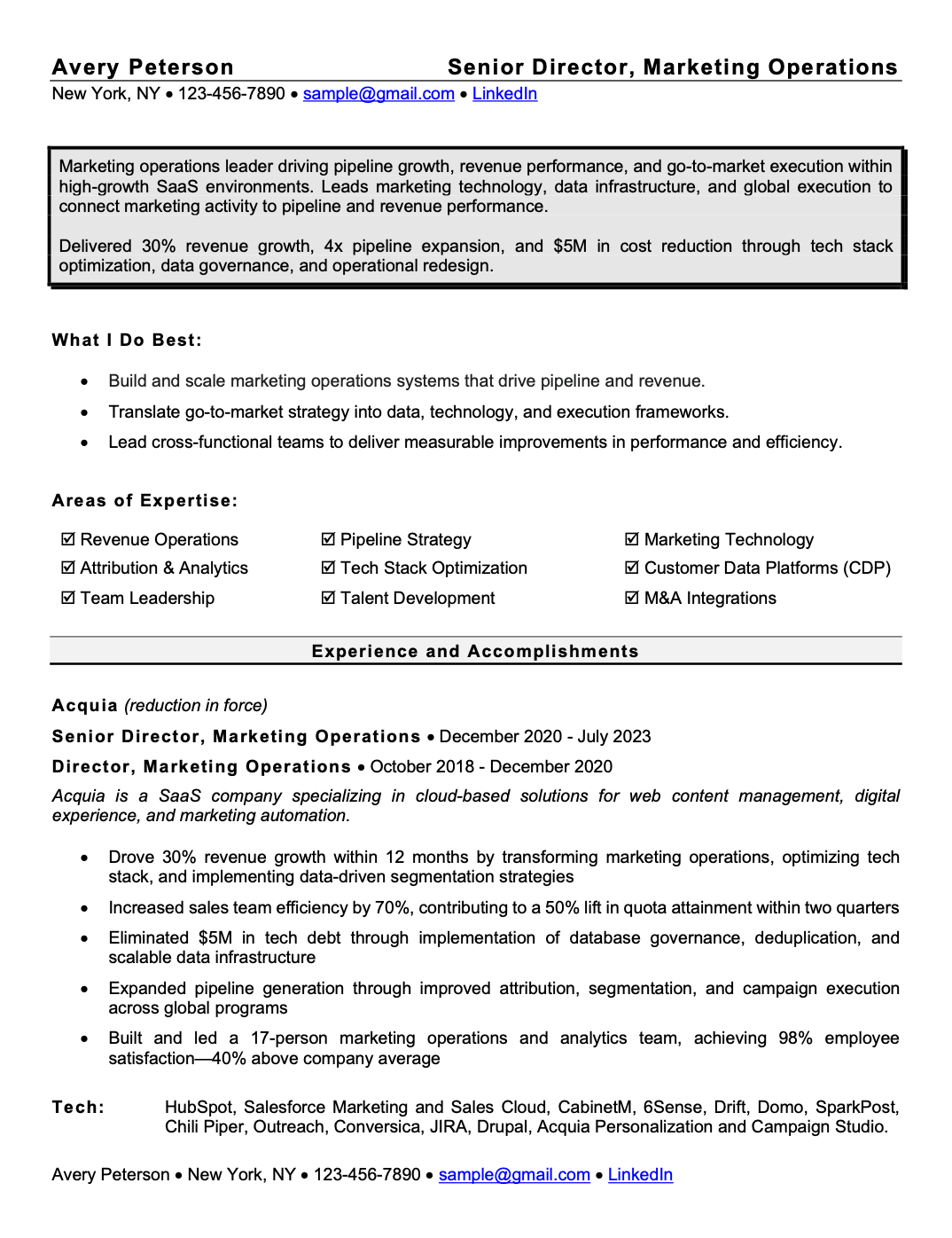
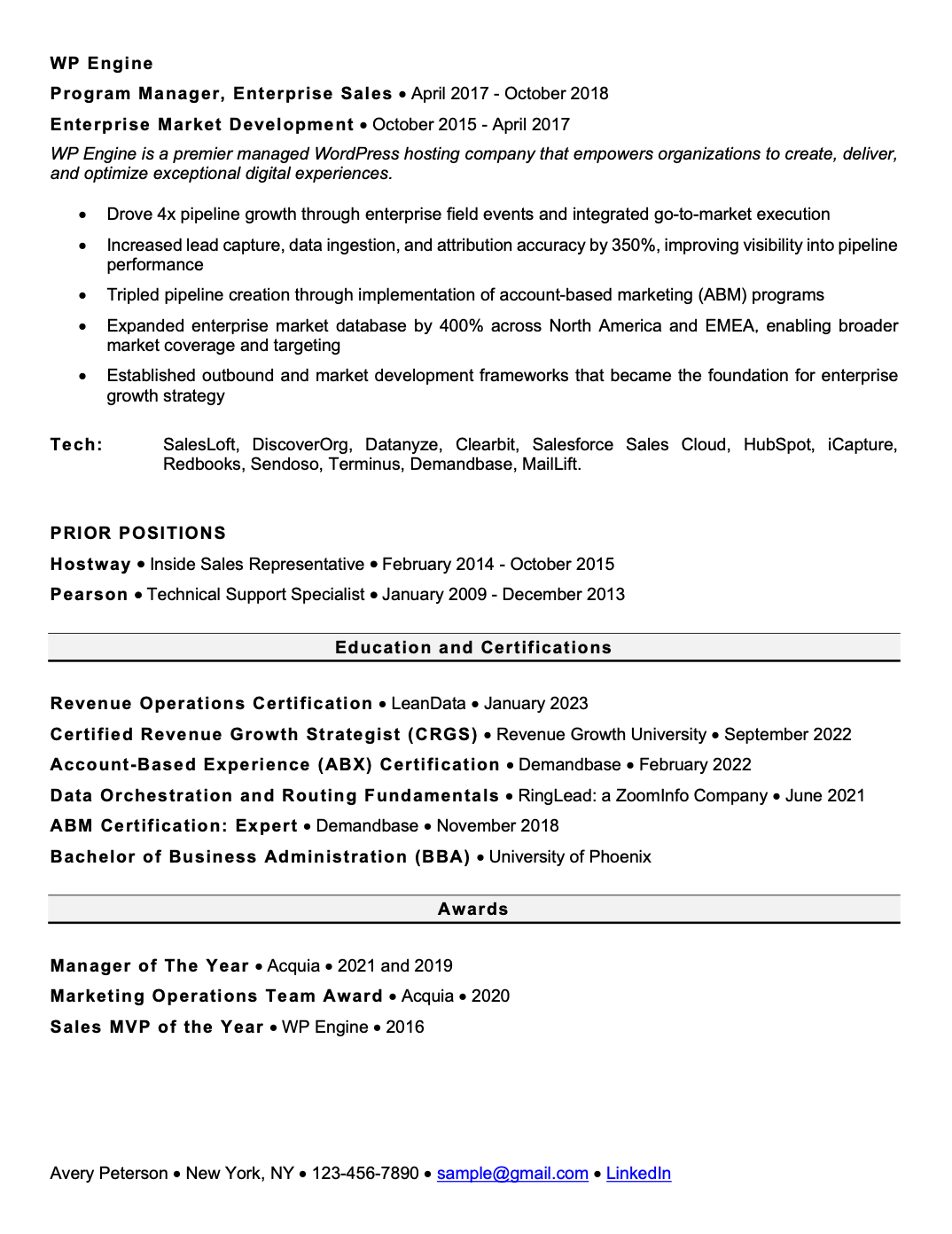
Talent Acquisition Leaders Haven't Wandered Too Far From the Work
Talent acquisition leadership has become harder to communicate and harder to define.
Many companies want a strategic partner who can advise executives, interpret talent-market conditions, improve hiring decisions, and build systems that scale. At the same time, they want someone willing to open LinkedIn Recruiter, engage passive candidates, troubleshoot a stalled search, and personally deliver critical hires.
That creates a positioning problem.
Lean too heavily into strategy, and the candidate may appear process-oriented, removed from recruiting, or better suited to managing a large established team. Emphasize hands-on execution, and years of leadership can disappear beneath a list of searches filled and requisitions managed.
The strongest resume does not choose between those identities. It demonstrates that the candidate’s proximity to the work is precisely what makes her a more effective leader.
The Strategy: Build the Resume Around an Operating Philosophy
This resume could easily have been organized around the conventional ingredients of a talent acquisition career: team leadership, technical recruiting, executive partnership, process improvement, and hiring metrics.
All of those elements are present, but they are not the story. The story is that this candidate makes hard hiring problems easier to solve.
That positioning creates a clear throughline across organizations of dramatically different sizes and stages. Whether she is rebuilding recruiting capability after a team elimination, leading eight recruiters across the Americas, developing an R&D recruiting team, or establishing a company’s first internal TA function, the underlying pattern remains consistent:
- Diagnose what is preventing the search from moving
- Clarify what the business actually needs
- Build enough structure to support better decisions
- Create a more effective path to the right talent
- Stay close enough to the work to know when the strategy must change
Instead of presenting leadership and execution as competing strengths, the resume shows how they reinforce one another.
Make the Value Proposition Visible Before the Work History Begins
A hiring leader should not have to read several pages of experience before understanding what distinguishes a candidate. The opening page therefore does more than provide a professional summary. It introduces a decision-making model.
The “How I Work” section identifies three behaviors that shape the candidate’s approach: solving the underlying problem, defining success before the search begins, and maintaining velocity when hiring activity stalls. Those ideas are immediately supported by selected results, including a 38-day average time to fill, 100% offer acceptance, candidate-experience scores above 90, a 57-day reduction in time to fill, a 45% improvement in hiring speed, and an 81% reduction in agency spending.
The metrics are not presented as an isolated highlight reel. They function as evidence for the positioning. That distinction matters. Impressive numbers may earn attention, but numbers connected to a clear leadership philosophy create credibility.
Turn a Varied Career Into a Coherent Leadership Story
Talent acquisition careers rarely unfold in a perfectly linear sequence. Leaders may move between management, consulting, and individual-contributor roles as companies restructure, markets contract, or the right business problem requires a different title.
Without careful positioning, that variety can look like inconsistency. This resume focuses the reader on increasing breadth rather than title progression alone. Each major role contributes a different dimension to the candidate’s value:
- At Twelve, she combines enterprise-wide hiring ownership with direct responsibility for difficult searches.
- At CyberArk, she demonstrates team leadership and recruiting delivery at scale.
- At Acquia, she pairs recruiter development with senior and critical technical hiring.
- At Nasuni, she proves she can build an internal recruiting function from the ground up.
- Her additional experience reinforces her ability to move between advisory work, specialized technical recruiting, and talent operations.
The result is not a collection of jobs. It is a record of increasingly sophisticated hiring problems solved across startups, scaling companies, and publicly traded organizations.
Use Detail to Demonstrate Judgment, not Just Activity
Most recruiting resumes are crowded with familiar responsibilities: partnering with hiring managers, sourcing passive candidates, improving processes, managing pipelines, and delivering an excellent candidate experience.
Those statements may be accurate, but they do little to differentiate one experienced recruiter from another. This resume uses selective detail to reveal judgment.
The expatriate sourcing example is a strong illustration. A difficult relocation requirement had narrowed the available talent market and stalled the search. Rather than continuing to work the same shrinking candidate pool, the candidate challenged the underlying assumption and identified U.S. professionals working abroad as a new source of potentially relocation-ready talent. The strategy generated interviews within one week.
That story communicates far more than sourcing ability. It shows curiosity, pattern recognition, commercial pragmatism, and a willingness to rethink the search itself.
Those are leadership capabilities—even when demonstrated through hands-on recruiting work.
The Real Goal: Make the Right Employer Recognize the Right Leader
An effective leadership resume should not attempt to make its owner appear suitable for every possible company.
This resume is intentionally positioned for organizations that need a talent acquisition leader who can operate at multiple altitudes: advising executives, improving hiring infrastructure, developing recruiters, interpreting funnel performance, and stepping directly into a critical search when the business cannot afford to wait.
That specificity may make the candidate less appealing to an employer seeking a highly removed administrator who delegates every aspect of recruiting delivery.
That is not a weakness. It is the positioning working correctly.
A strong resume does not merely increase the number of opportunities a candidate can pursue. It helps the right organizations understand, quickly and accurately, why this particular candidate is equipped to solve the hiring problems they actually have.
Ready to Fix the Gap?
If your resume reads like a catalog of recruiting responsibilities, hiring volume, and positions filled, it may be documenting your career without fully explaining your value.
We'll identify the patterns that make your experience distinctive: the problems you are repeatedly trusted to solve, the judgment behind your results, and the environments in which you create the greatest impact.
Then we build the resume around that argument and show why a company should trust you with the future of its workforce.