
Chief Strategy Officer Resume Example
A Chief Strategy Officer Resume Should Show How Strategy Becomes Action
This candidate had no shortage of impressive outcomes: $55M in funding, an unprecedented 14.1-point voter shift, growth from 7 to 28 employees, and a public-health program adopted by more than 500 U.S. parks. The challenge was showing that these accomplishments were not disconnected successes across nonprofit leadership, political advocacy, and public health.
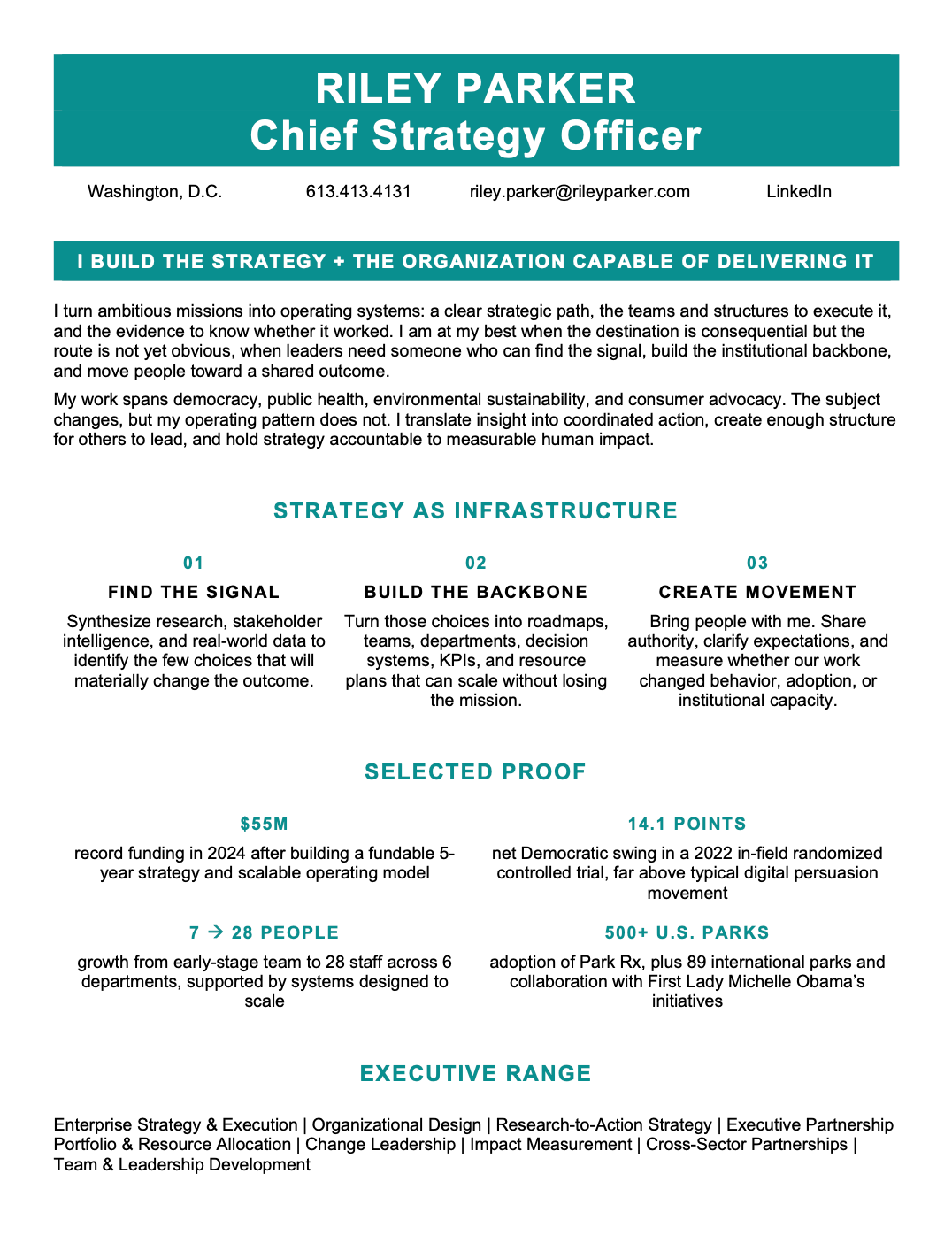
We built the resume around a defining idea: Riley builds the strategy, and the organization capable of delivering it.
The first page introduces their repeatable operating model: find the signal, build the backbone, and create movement. That framework connects her ability to identify the choices that matter, create the teams and systems required to execute them, and measure whether the work changed behavior or expanded institutional capacity.
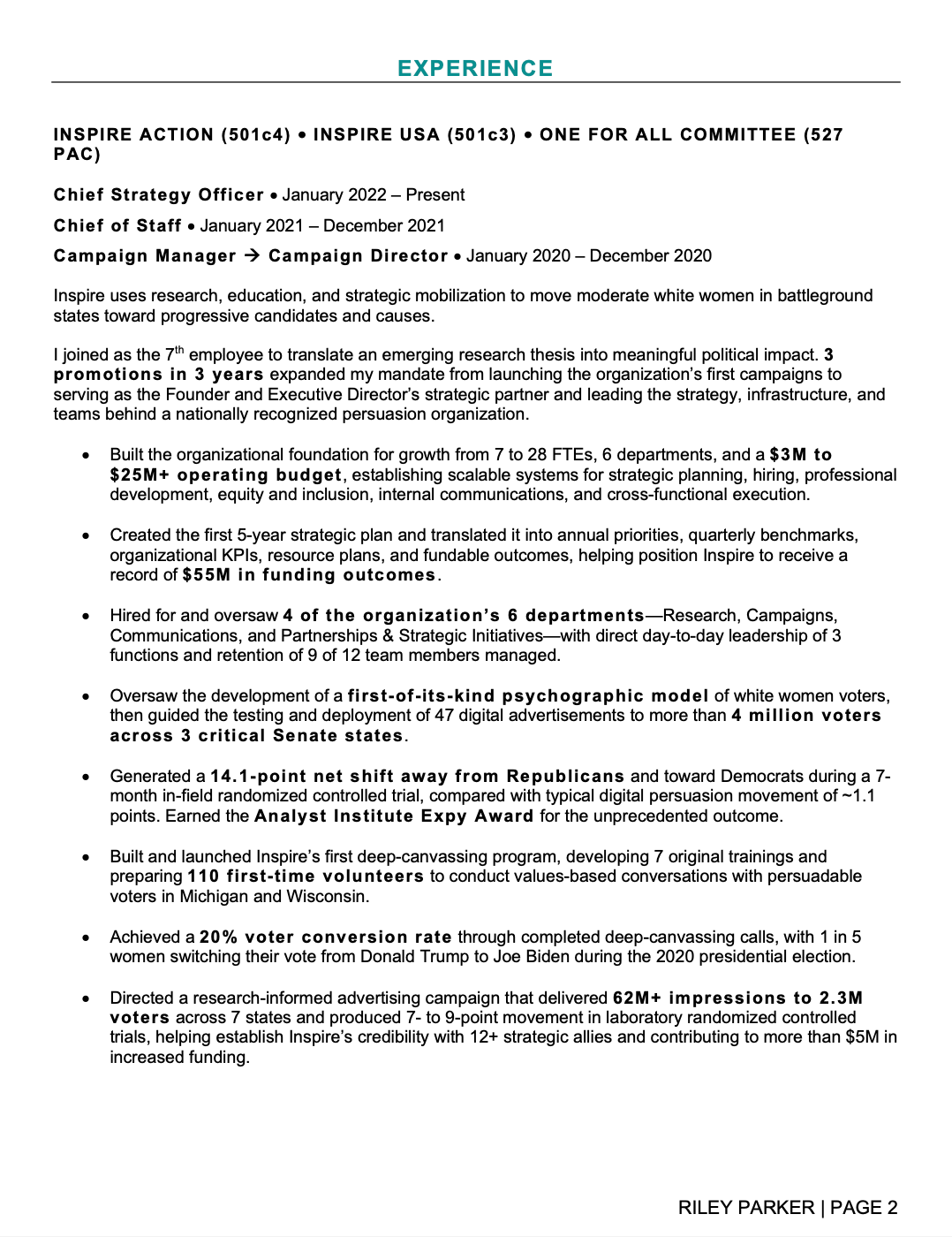
The remaining pages provide evidence through a traditional, ATS-compatible chronology. Together, they position Riley not simply as a mission-driven leader with broad experience, but as a Chief Strategy Officer who turns ambitious visions into scalable organizations and measurable impact.
Strategy Is Only as Strong as the Organization Built to Deliver It
Ambitious ideas rarely fail because no one can imagine the destination. They fail in the distance between vision and execution—where priorities become fragmented, ownership remains unclear, and the organization lacks the infrastructure to move forward.
Riley had repeatedly closed that distance. She helped scale an organization from 7 to 28 employees, built the strategic foundation for $55M in funding, generated an unprecedented 14.1-point voter shift, and created a public health program adopted by more than 500 U.S. parks. But without a unifying narrative, those accomplishments could still look like separate successes across nonprofit leadership, political advocacy, and public health.
The resume needed to reveal what connected them: Riley does not simply create strategy. She finds the signal within complexity, builds the organizational backbone required for execution, and creates measurable movement.
The Situation
Riley was already a Chief Strategy Officer. The challenge was not convincing hiring teams she could grow into the title. It was making the full scope of her leadership, and its relevance beyond one organization or sector, immediately clear.
At Inspire, she had operated at the intersection of enterprise strategy, organizational design, executive partnership, research, talent development, resource allocation, and political persuasion. Earlier in her career, she had transformed research into public-health programs, built cross-sector partnerships, and introduced the systems teams needed to execute more effectively.
Her resume documented those experiences, but it didn't yet explain what they added up to.
What Wasn’t Working
- Her executive identity was too broad. Her old resume read, “Transforming ambitious visions into actionable strategies,” which described Riley accurately, but did not distinguish her from other strategy executives. Her real advantage is more specific: she can determine what matters, create the structure required to act on it, and hold the work accountable to measurable outcomes.
- The political results dominated the organizational story. A 14.1-point voter shift, a 20% conversion rate, and millions of voters reached were naturally attention-grabbing. But they could pull the reader toward a narrower conclusion: accomplished political strategist. The resume gave less visual and narrative weight to the 5-year strategy, 4-department structure, leadership systems, hiring plans, KPIs, and operating infrastructure that made increasingly sophisticated work possible.
- Her career logic was hidden inside the chronology. Public health, environmental sustainability, consumer advocacy, and political persuasion can look like unrelated fields. The traditional role-by-role structure showed where Kristin had worked, but it left the reader responsible for discovering the strategic method she carried from one environment to the next. That was too important to leave to inference.
What We Changed
1. Defined Strategy as Infrastructure
We repositioned Riley’s value around a central belief: strategy is not complete when the plan is written. It becomes real when an organization has the priorities, people, systems, authority, and evidence required to deliver it. That idea gave the resume a sharper executive point of view and a standard against which every accomplishment could be evaluated.
2. Made Her Operating Sequence Memorable
The first page organizes Riley’s work into 3 connected movements:
- Find the Signal: Synthesize research, stakeholder intelligence, and real-world data to identify the choices most likely to affect the outcome.
- Build the Backbone: Turn those choices into plans, teams, departments, decision systems, KPIs, and resource models that can scale.
- Create Movement: Enable people to act, then measure whether the work changed behavior, expanded adoption, or strengthened institutional capacity.
This is not a list of competencies. It is an explanation of how she leads.
3. Rebalanced Organizational Leadership and External Impact
The revised resume places Kristin’s internal and external results in the same strategic story. Growth from 7 to 28 employees, 4 departments, a $3M to $25M+ operating budget, and $55M in funding demonstrates the organizational capacity she helped create. The 14.1-point voter shift, 20% conversion rate, and award-winning campaign results demonstrate what that capacity made possible.
One set of accomplishments explains the other.
4. Used Earlier Roles to Establish a Pattern
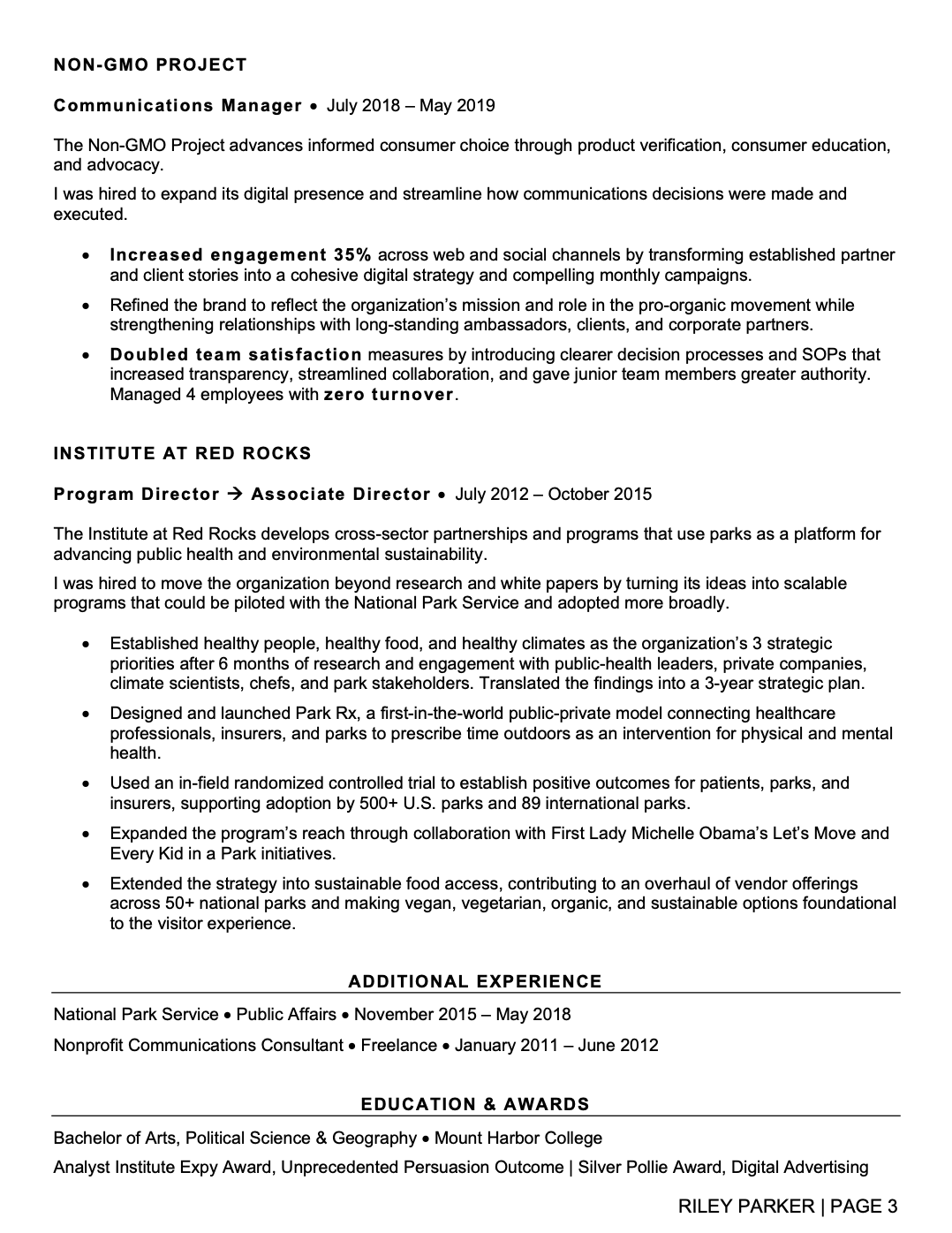
The Institute at Red Rocks was not treated as an interesting but unrelated chapter. It became evidence that Kristin had been doing this work long before she became a Chief Strategy Officer: identifying strategic opportunities, converting research into a scalable operating model, aligning stakeholders, measuring outcomes, and expanding adoption. Park Rx reaching more than 500 U.S. parks and 89 international parks reinforces the same executive identity established through her current work.
5. Kept the Experience Section Familiar
The first page carries the editorial concept. The experience section returns to a conventional chronology with recognizable employers, titles, dates, organizational context, and accomplishment bullets. That balance matters. The resume is distinctive enough to be remembered, but familiar enough for recruiters, hiring executives, applicant tracking systems, and AI-assisted screening tools to navigate easily.
Why This Works
The resume no longer asks the reader to assemble Riley’s executive identity from scattered evidence. Within the first page, a hiring team can understand:
- What kind of Chief Strategy Officer she is
- How she approaches complex and ambiguous problems
- What she builds inside an organization
- How she enables other leaders to execute
- What kinds of measurable outcomes her approach has produced
The chronology then substantiates that positioning without repeating it. This gives Riley room to pursue Chief Strategy Officer, Chief of Staff, Chief Impact Officer, Managing Director, and Vice President roles while maintaining one coherent executive identity.
The Bigger Point
Transferability does not come from making a candidate’s experience sound generic. It comes from identifying the method that remains valuable when the organization, sector, or problem changes. Riley’s career spans several mission-driven fields, but her value is not confined to any of them. What travels is her ability to move from incomplete information to strategic clarity, from strategic clarity to organizational capability, and from organizational capability to measurable change. Once that pattern becomes visible, breadth stops looking like a lack of focus. It becomes evidence of range.
The Result
The finished resume presents Riley as the architect behind both the strategy and the conditions required to execute it. Her political outcomes no longer obscure her enterprise leadership. Her earlier roles no longer feel disconnected from her current authority. Her metrics do more than prove she has been successful; they demonstrate that her way of leading works.
The first page establishes the operating model. The remaining pages show it working across different problems, organizations, and stages of growth. The result is a Chief Strategy Officer resume with a clear point of view, credible executive scope, and a career story that can travel.
*Client details have been modified to protect confidentiality while preserving the strategic positioning and outcomes.
Ready to Fix the Gap?
You may already be operating at the level of your target role while your resume continues to present the pieces of your career separately.
Ivy Blossom Recruits identifies the idea connecting those pieces and builds an executive resume that communicates not only what you have accomplished, but why your approach creates value.